Industry Education
CompStak Put Its Comps Inside Claude and ChatGPT. What Is Left for a Tenant-Rep Broker to Own?
By Casey Krueger, Founder & CEO, BrokerHQ · Published October 4, 2026 · 7 min read
What did CompStak actually launch?
Agent Connect is an MCP server. MCP (Model Context Protocol) is the open standard that lets an AI assistant call outside tools and read outside data in a structured way instead of guessing from training data. If the term is new, our earlier post on what MCP means for tenant-rep brokers covers the mechanics.
According to CompStak's launch post, Agent Connect exposes verified lease, sale, property and loan data, plus market analytics such as net effective rent and lease terms, through natural-language queries. It works with ChatGPT, Claude, Copilot, Gemini and agents a firm builds itself. It is sold inside a new subscription tier called CompStak One Connect, which also includes Rent Predictor, a model that estimates starting rent for spaces with no recent comparable deals. Pricing was not published.
CompStak says its comps are crowdsourced from more than 40,000 brokers, appraisers and researchers, then checked with statistical anomaly detection and in-house analyst review, across 105 US markets. Those are the vendor's own numbers, so treat them as claims until you test coverage in your own submarkets. CEO Michael Mandel framed the pitch as getting from a question to a sourced comp set "with no integration project."
Why does it matter that three vendors shipped the same pattern within two days?
Lofty, a residential brokerage platform, announced an MCP server on September 30 so brokerages can plug in their own agents and data. Rabbet, a construction finance platform, announced a read-only MCP connector on October 1 for budgets and draw histories. Neither is a tenant-rep tool. The point is the pattern: the data vendor stops asking you to log into its dashboard and starts showing up inside the assistant you already use.
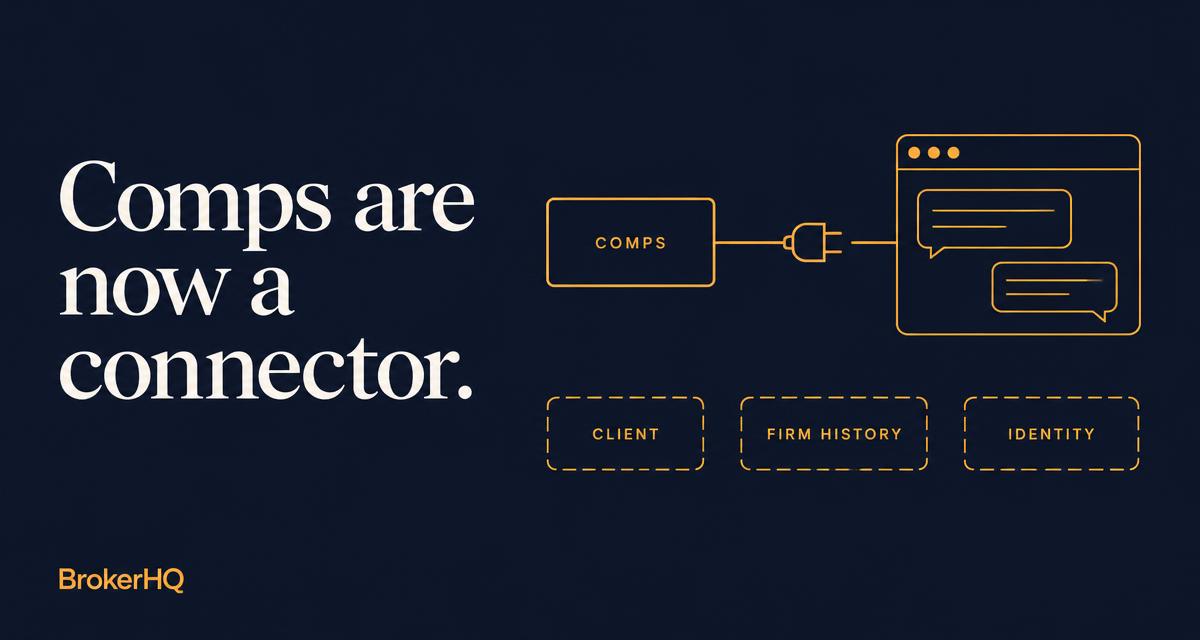
For a Seattle tenant-rep desk, that changes the buying question. A dashboard is a place you visit. A connector is a source your assistant can reach. Once your assistant can reach two or three sources at once, the value moves to whoever controls the question being asked and the context it is asked in.
When a comp set arrives in one prompt, the comp set stops being the product a broker sells.
What does a comp connector solve for a tenant-rep broker?
Quite a lot, and it is worth saying so plainly. Pulling comparable leases, benchmarking net effective rent across submarkets, and checking what a vacancy might price at are all repetitive, high-frequency tasks. The CompStak announcement lists exactly those: comparing net effective rents across submarkets, benchmarking lease rollover risk, pricing upcoming vacancies.
An editorial from the AI for CRE Collective the day before the launch described the current cost of doing this without a connection: the human "is actually still doing most of the integration work," copying between a chat window, a CRM and a spreadsheet. A connector removes one of those hops. Removing a copy-paste hop is real value, and brokers who dismiss it will be slower than brokers who take it.
What does it leave unsolved?
A comp is a record of a deal that already closed. A tenant-rep requirement is about a deal that has not happened yet, for a client with a specific headcount, growth path, budget and lease clock. Three gaps sit between those two things.
First, the live landscape. Comps tell you what space like this rented for. They do not tell you which companies are about to need space, which tenants in a building are shrinking, or which suites are coming back before they are marketed. That signal lives in business licenses, WARN notices, permits and filings. We covered how that works in public-records tenant move signals.
Second, your own context. The client who walked away from a tower over a parking ratio, the landlord who concedes on free rent but never on TI, the three buildings your firm has toured for this exact tenant before. None of that is in a vendor's comp database, and the most valuable data on a tenant-rep desk is the data the desk already generated and never wrote down in one place. The idea of keeping it queryable is what we meant by firm memory.
Third, identity. A comp says a company leased 8,000 square feet. Whether that company is the same entity your client is negotiating against, which LLC owns the building, and who actually signs are separate questions, and tracing them takes its own work.
BrokerHQ's current focus is that underlying layer: tenant and property identity, contacts, lease expirations and the relationships between them, so that a connector like CompStak's has something to join against. That is a direction, not a claim that every piece is live today.
What is the honest case that comps are enough?
The strongest version goes like this. Most tenant-rep conversations with a landlord turn on comps. If an assistant can produce a sourced comp set in a single session, a three-person desk gets analyst-grade output without an analyst, and the broker's time moves to negotiation. For many deals that is the whole job.
I think that is right for a straightforward renewal in a deep submarket. It gets weaker where comps are thin, which is exactly where Rent Predictor exists, and where a modeled rent replaces observed deals. CompStak describes the model as estimating rent for spaces without recent comparable deals. A broker defending a number to a client should know whether the number is an observed deal or a model output. I have not benchmarked Seattle coverage in Agent Connect, and the pricing tier is unpublished, so the only responsible position is to test it.
The second counterpoint is that the connector is a feature of an existing subscription tier, not a free layer. A desk that already pays for CompStak gains a new interface. A desk that does not has a new line item to justify.
What should a desk ask before buying any vendor's agent connection?
- Is it read-only, and who controls access? Rabbet states read-only permissions and admin revocation. Ask every vendor the same, and ask what the assistant can do beyond reading.
- What happens to my prompts and my firm's data? If you paste client details into a query, where do they go, and are they used for training or for improving the vendor's own dataset?
- Can it join with my data, or only answer in isolation? A connector that cannot sit next to your own deal history and your client's constraints gives you a better lookup, not a better workflow.
- Does it tell me when a number is modeled instead of observed? Provenance on every figure is what lets you defend it in front of a client.
What can you test this week?
Take one live deal. Pull its comp set your usual way and time it. Then, if you have access to any vendor connector, pull it through your assistant and time that. Write down every piece of context you still had to supply by hand: the client's constraints, the buildings already toured, the landlord's history. That list is the part of your job no connector replaces, and it is the part worth writing down in one place.
Frequently asked questions
What did CompStak launch?
Agent Connect, an MCP server launched September 29, 2026 that lets verified lease and sale comps be queried in ChatGPT, Claude, Copilot, Gemini and custom agents, sold in the new CompStak One Connect tier alongside Rent Predictor.
Does a comp connector replace a tenant-rep broker's data work?
No. Comps record closed deals. A requirement also depends on the live landscape of expiring and shrinking tenants, the firm's own deal history, and company and building identity, none of which a comp database supplies.
What should a desk ask before buying a vendor's agent connection?
Whether it is read-only and who controls access, what happens to prompts and firm data, whether it can join with the desk's own data, and whether it labels modeled numbers separately from observed deals.
Are comps from a connector enough for a renewal?
For a straightforward renewal in a deep submarket they may be. Where comps are thin, rent is a modeled estimate, and a broker should know whether a figure is observed or modeled.
Sources
- CompStak, "CompStak Launches Agent Connect, an MCP Server for Verified Commercial Real Estate Data," September 29, 2026.
- CompStak, "Introducing Agent Connect: Access CompStak insights anywhere you work."
- AI for CRE Collective (PLOT Daily): "CompStak puts verified CRE data inside AI agents," September 29, 2026; "Copy-pasting into ChatGPT is not an AI strategy," September 28, 2026; "Lofty lets brokerages bring their own AI agents," September 30, 2026; "Rabbet launches AI connector for project finance," October 1, 2026.
See sourced intelligence on your market
Every claim linked back to the filing or record it came from.