Industry Education
Where Is the AI Money Going in Commercial Real Estate? Four 2026 Rounds, and None of Them Names Tenant Reps
By Casey Krueger, BrokerHQ · Published November 8, 2026 · 5 min read
Figures as of Q3 2026.
Who raised money for AI in commercial real estate in 2026?
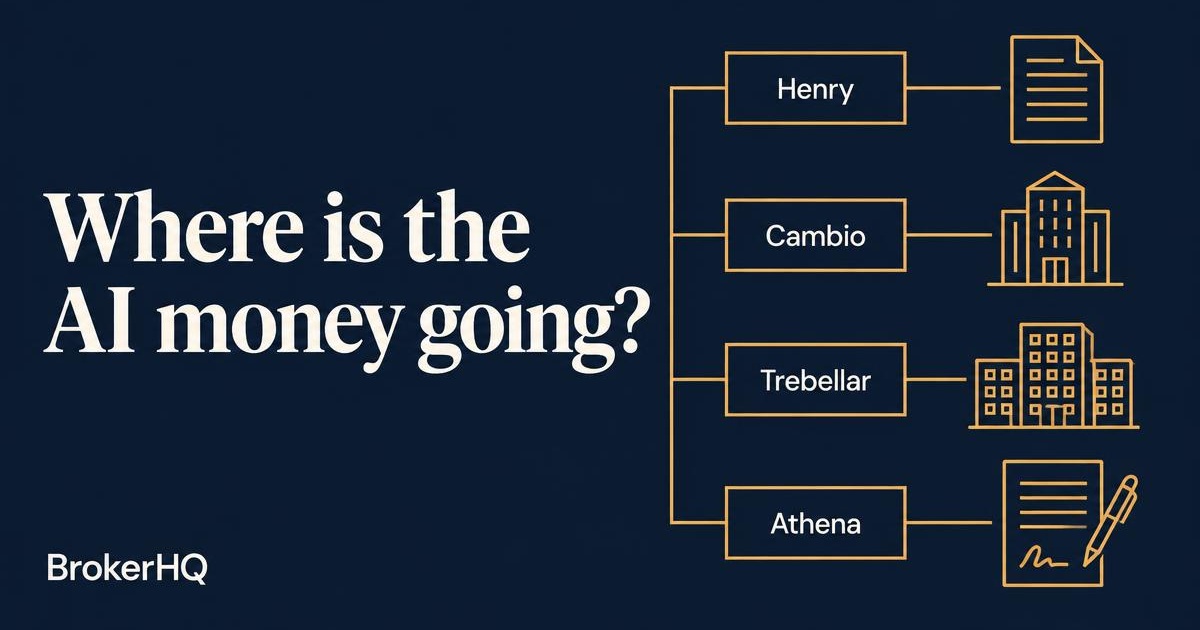
Henry AI announced a $16.5 million Series A on July 29, 2026, led by FirstMark Capital with Thomson Reuters Ventures participating, alongside the launch of Henry Deal, which covers the deal from underwriting to close. Its release describes document-heavy production work for CRE firms: offering memorandums, underwriting, pitch decks, buyer lists. Cambio announced an $18 million Series A in January 2026, led by Maverick Ventures, for owners, investors and operators of commercial buildings, covering building data, retrofit priorities, capital planning and regulatory compliance.
Trebellar announced an $18 million Series A on September 24, 2026, led by Blossom Capital, for corporate real estate teams at large companies. Its release names Meta, Uber, Merck and Cohesity as users and describes a live view of space, cost and utilization. Athena, per Forbes on November 3, 2026, raised a $2.5 million pre-seed from a16z Speedrun to run an AI-enabled law firm for CRE deals, with attorneys reviewing the AI's document work.
What do the four have in common?
Each one is built around a document, a portfolio or a balance sheet. Henry produces deal documents, Cambio models a building's capital plan, Trebellar keeps a company's occupancy picture, and Athena drafts and reviews agreements. The users are the people who own, finance, underwrite or legally close commercial property, or who manage a large occupier's portfolio.
Added up, the rounds come to $55 million. That is a useful number for one reason: it shows where investors have been willing to place bets in this category in the past ten months.
Where does tenant representation fit?
None of the four announcements I read mentions tenant representation. Tenant-rep work looks different from the products above. It is a sequence of market surveys, building comparisons, tours and lease negotiations on behalf of one occupier, and the facts that decide it sit at the building level: what is available, what is on sublease, who owns it and how they are financed. In Seattle's Q3 2026 market, with total vacancy in the Seattle CBD at 35.0% per Kidder Mathews, that building-level sorting is most of the job.
My read, labeled as inference: a funded company has to pick a buyer who can sign a large contract, and the boutique tenant-rep brokerage is a small buyer with a workflow that a deal-production or portfolio tool does not touch.
Is Trebellar a tenant-rep tool?
No, though it is the closest. Trebellar serves in-house corporate real estate teams, which sit on the tenant's side of the table. A tenant rep is an outside advisor with a different workflow: the search, the survey, the tour book, the negotiation. A tool for an occupier's portfolio team does not produce a tour book.
What is the honest counter-argument?
Funding is a lagging and lumpy signal. A press release names the buyer a company wants investors to see, and a product may serve more users than its announcement says. I read four announcements, not four products, and I left out a fifth, CarbonAI, because I could not read its coverage. There may also be tenant-rep tools that have not raised outside money. And the absence of funded competitors can mean the market is small or hard as easily as it can mean it is open.
What should a tenant rep ask an AI vendor?
Three questions. Which workflow was this built for first? Who are the named customers, and do any look like a boutique tenant-rep shop? Can I run it on my last tour book or market survey before I sign anything? A demo on a clean sample says less than one bad real input.
What can you do this week?
Write down your five most repeated tasks in a deal, with the time each takes. Take that list to any vendor demo and ask which of them the product does today.
At BrokerHQ we are building for that tenant-rep workflow, with each building fact tied to a source, a definition and a date. Not every piece is live today, and we will say which ones are when they ship.
Sources
Frequently asked questions
Which commercial real estate AI companies raised money in 2026?
Four announcements covered here: Henry AI ($16.5M Series A, July 2026), Cambio ($18M Series A, announced January 2026), Trebellar ($18M Series A, September 2026) and Athena ($2.5M pre-seed, November 2026).
Who are these CRE AI products built for?
Henry targets deal production at CRE firms, Cambio targets owners, investors and operators of buildings, Trebellar targets corporate real estate teams at large occupiers, and Athena is an AI-enabled law firm for CRE deals.
Do any of these announcements mention tenant representation?
Not in the announcements read for this post. That says something about where these companies positioned themselves, not about whether tenant-rep AI exists elsewhere.
What should a tenant rep ask an AI vendor?
Ask which workflow the product was built for, who its named customers are, and test it on your last tour book or market survey rather than on a demo.