Industry Education
A Business License at 999 Third Ave Does Not Mean a Tenant Sits There. How to Read Seattle Occupancy Data.
By Casey Krueger, Founder & CEO, BrokerHQ · Published October 11, 2026 · 7 min read
What did the test actually ask an AI agent to do?
Five jobs against public Seattle and federal data: Form D filings in the last 90 days, every business at one downtown tower plus its permits, electrical contractors by permit volume, King County SBA borrowers that also hold federal contracts, and what changed at one address over three years. The agent used Python, the public APIs and web search. Tool time across all five was about 15 minutes plus a few fix cycles.
One caveat belongs up front. The tester already knew which endpoints to call and which traps to look for. A broker typing a plain prompt into an assistant would probably take longer and miss more.
Can an AI agent list every business at a Seattle office address?
Yes, and fast. At 999 Third Avenue it returned 65 active business licenses, one building permit since October 2024 (a 40th-floor tenant improvement issued June 24, 2025), and 21 electrical permits, all from Seattle open data.
Producing the list is no longer the hard part. If your edge is that you can assemble a list of companies in a building, an assistant now does that for the price of a monthly subscription.
Why is a license address not the same as occupancy?
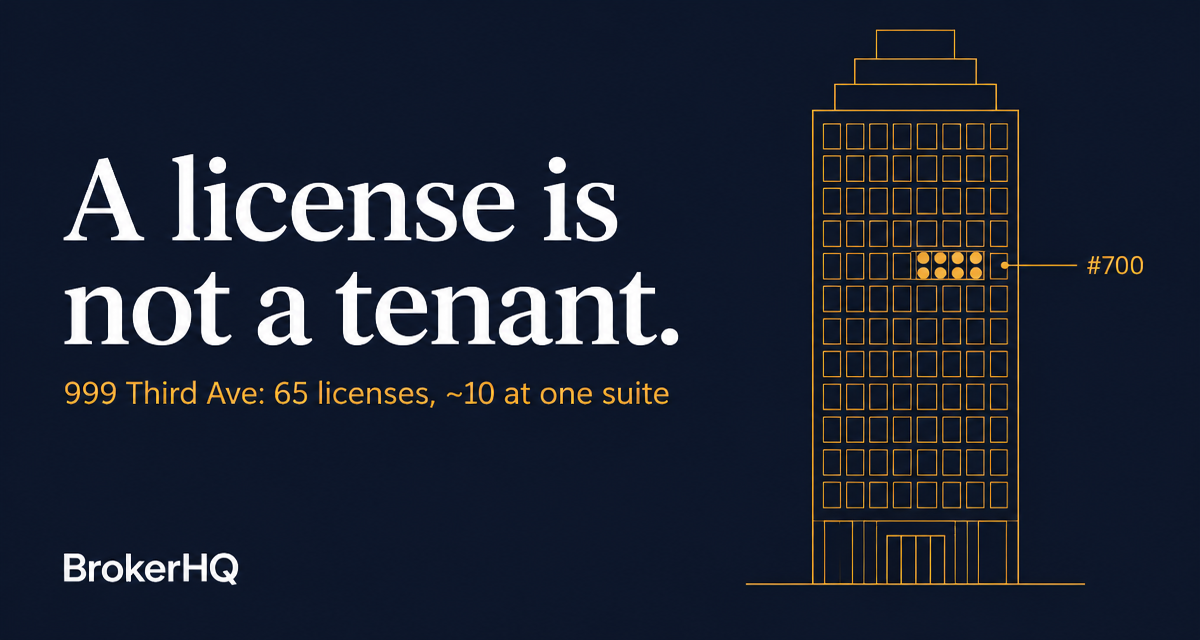
Because a license records where a business registered, not where its people work. About 10 of the 65 licenses sat at "#700," a shared or virtual-style suite. The suite strings were also inconsistent ("# 33," "# STE 700," "# FL 11"), so a naive count of tenants per floor is wrong before you start.
The same trap showed up in the Form D task. Several filing addresses were mailboxes, for example 1522 Western Ave #24336, which says nothing about office space. A Seattle-only city filter also misses companies whose principal office is elsewhere.
A company licensed at an address and a company occupying space at that address are two different facts. Treating them as one produces a prospect list full of companies with no lease to expire.
What other traps show up in public Seattle data?
Three more, all from the same test:
- Missing and split names. Of 25,491 electrical permits in 12 months, 4,775 (19%) listed no contractor. Raw counts split one firm into "Cochran, Inc." (311) and "Cochran Inc" (247). After normalizing names, the top "electrical contractor" by volume was a heating company.
- Cumulative and duplicate filings. Form D "amount sold" is cumulative and can predate your window, and amendments double count.
- Wrong government records. SBA listed one borrower on "5th Avenue Southwest" while the firm's own site gives a different street address. A fuzzy name match also proposed two likely different firms as one.
Each of these is a plausible-looking row. None is obviously wrong until someone who knows the market looks at it.
Why could the agent not answer "what changed at this building in three years"?
Because the city portal publishes only current active licenses. The Wayback Machine held one full export, from March 25, 2021; later captures were 1,000-row partials. Comparing 2021 to 2026 instead, the building went from 99 licenses to 65: 38 stayed, 61 were gone and 27 were added. Of the 61 gone, 17 still hold a Seattle license elsewhere.
Then the agent nearly shipped an error. One firm looked like a departure, but it was still in the building under a new account number. That is a same-building account change read as a move. After that correction, 44 departures stayed unexplained.
You cannot reconstruct a history nobody stored. If you want to know who left a building, when, and where they went, someone had to take the snapshot at the time. That cuts both ways for a tenant-rep desk: it is why lease-expiry timing is so hard to buy, and it is why a desk that writes down what it sees each quarter builds something a subscription cannot sell it later.
How should a tenant-rep read license, permit and filing data?
Five checks before you treat a row as a prospect:
- Normalize the suite. Strip "#", "STE," "FL" and "Suite," then compare. Otherwise you split one tenant into three.
- Count licenses per suite. Many unrelated businesses on one suite number is a shared or virtual address until proven otherwise.
- Look for a physical signal. A tenant-improvement permit on that floor, a lobby directory listing, or a recent hiring post at that address are stronger evidence than a license.
- Ask who is NOT in the data. Contractors missing from 19% of permits means one in five records cannot be attributed. Missing is not zero.
- Date everything. Write down the day you pulled it. A current-only portal makes today's pull the only record of today.
What does this mean for how we build?
The part of this test that matters to us is the failure list. Lists are cheap now. Resolving which company occupies which suite, with the evidence attached, and keeping dated snapshots so the answer to "what changed" exists later, is the work we are building toward at BrokerHQ. We treat an occupancy as a claim with a source and a date, not a row. Not every piece of that is live today, and we will say which parts are when they ship.
What is the honest counter-argument?
A fair broker would say this is a lot of ceremony. Walk the lobby, read the directory, call the property manager, and you know in ten minutes who is in a building. For one building that is true and often faster.
The problem is scale. Prospecting across 150 buildings in a submarket does not allow a lobby visit each, and that is where a license list with silent shared-suite noise wastes calls. Agents will also get better at flagging shared addresses; the test did not show a ceiling on that. What no better model can do is recover the snapshots that were never taken.
What can you test this week?
Pick one building you know well. Pull its active licenses from the city portal and count how many you can confirm with a person who works there. The gap between the licensed count and the confirmed count is your noise rate for that building. Write it down with today's date.
Sources
- AI research agent live test of five Seattle and federal public-records tasks, run October 8, 2026 using Seattle open data, SEC EDGAR full-text search, SBA 7(a)/504 FOIA data, USAspending and Wayback Machine captures.
- Seattle Open Data: active business license and building and electrical permit datasets (City of Seattle).
- U.S. Securities and Exchange Commission, EDGAR Form D filings.
- U.S. Small Business Administration, 7(a) and 504 FOIA loan data.
- Internet Archive, Wayback Machine capture of the City of Seattle business license export, March 25, 2021.
Frequently asked questions
Can an AI agent tell which companies occupy a Seattle office building?
It can list the businesses licensed at an address in minutes, but a license shows where a company registered, not where it has space. In an October 8, 2026 test, about 10 of 65 licenses at one tower sat at a single shared-looking suite.
Why can't public data show what changed at a building over three years?
The City of Seattle portal publishes only current active licenses, so history exists only where someone stored snapshots. The test found one full archived export from March 2021.
How do I check whether a licensed company really occupies a suite?
Normalize suite numbers, count licenses per suite, look for a physical signal such as a tenant-improvement permit or a lobby directory listing, and date every pull.
Related reading
See sourced intelligence on your market
Every claim linked back to the filing or record it came from.